

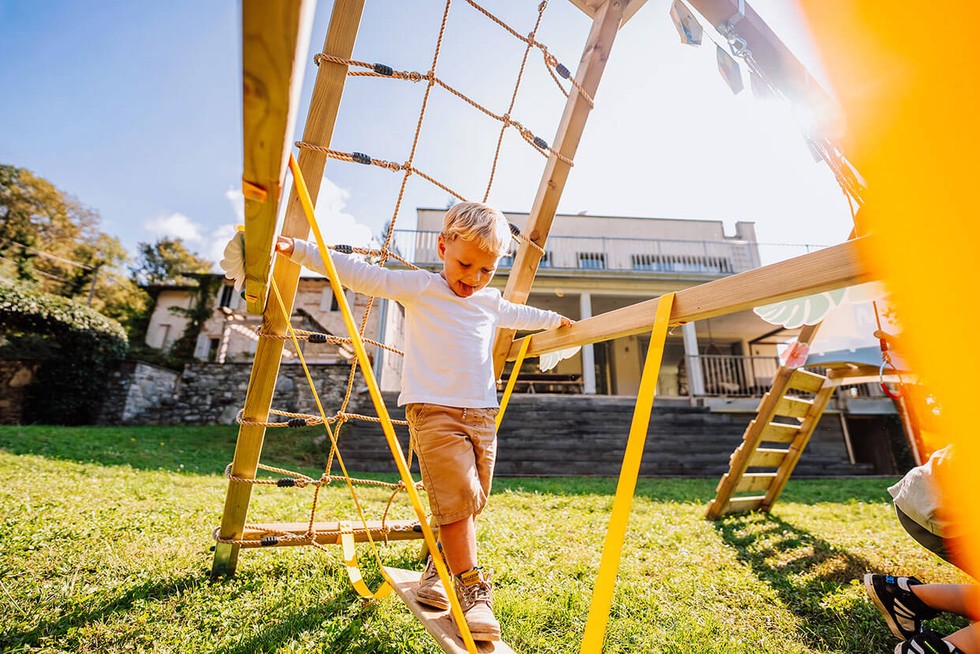
Children often return to climbing activities because the same structure can present a new challenge over time. A younger child may concentrate on reaching one step with confidence. Later, they may want to move across a longer section, try a different route or show a friend how they do it.
That changing experience is one reason families consider Monkey Bars for a backyard play area. The appeal is not limited to completing the bars from one end to the other. Reaching, hanging, climbing and inventing games around a frame can offer different kinds of play, provided the setup suits the children using it.
Progress can happen in small steps
Adults may picture a child moving smoothly across a full set of bars, but early progress often looks much smaller. A child might first learn where to place their hands, practise holding on briefly or become comfortable climbing up and back down. Each step can feel important to them.
Give children time to explore without turning every attempt into a performance. Some will ask for help; others will prefer to try a manageable part independently while you supervise. Encouragement is useful, but pressure to finish a route can take the pleasure out of it. Climbing remains interesting when children can notice their own progress.
The same frame can inspire different games
A climbing frame is not only a fitness challenge. Children may turn it into a mountain, an obstacle course or part of a game with siblings. They might travel one way today and make up a new route tomorrow. This imaginative element can help a familiar structure feel different each time.
Leave some room around the equipment for those games to develop. If every part of the yard is filled with fixed features, children have less space to create their own rules. Ask them what they have been playing rather than assuming you know from watching. Their answers may show you how much variety they have found in a simple setup.
Children build confidence at different rates
One child may be eager to climb high; another may need time near the lower parts of a structure. Neither approach needs correcting. The useful question is whether the activity is appropriate for the child and whether they feel comfortable trying it.
Follow the equipment’s age and use instructions, and supervise according to the child’s abilities. Offer support where needed without doing the whole activity for them. As children become more familiar with a route, they can make more decisions about how to move. That sense of ownership often matters as much as the physical achievement.
Friends change the experience
Climbing alone can be absorbing, but playing with friends adds a social dimension. Children may take turns, suggest routes or create games that include someone who does not want to climb. A frame can become a meeting point rather than the whole activity.
Talk about safe turn-taking and be aware of how many children are using the equipment. Excitement can make it easy to crowd one section or move into another child’s path. Clear, simple expectations help the game continue without constant adult direction. The goal is to support play while stepping in when safety or fairness calls for it.
A changing challenge needs a suitable setup
As children grow, they may be ready for different activities, but that does not mean every frame can be used in every way. Check the specifications and load guidance for the particular equipment. If it offers adjustable features or compatible accessories, follow the maker’s instructions when changing the setup.
Resist improvised additions that have not been approved for the frame. A rope, board or attachment that appears harmless can change how weight is applied or create an unexpected risk. If children ask for a new challenge, look for suitable options or make up a ground-level game around the existing structure.
Make the surrounding area inviting
Where the frame sits affects how often it is used. A spot exposed to strong afternoon sun may be appealing for only part of the day. An area that stays wet after rain can become difficult to approach. Observe shade, drainage and access before choosing a location.
Provide room for children to get on and off the equipment without colliding with furniture, fences or other play features. Follow installation and clearance instructions. Keeping the area tidy makes it easier to see what is happening and to inspect the frame. The space around the equipment is part of the play environment.
Balance climbing with other play
Climbing does not need to be the answer to every request to go outside. Children may want to dig, draw, chase a ball or sit quietly after an active game. Leaving space for those choices makes the backyard more useful.
It also lets children return to climbing because they want to, not because it is the only activity available. A short attempt followed by a completely different game can still be a satisfying afternoon. Adults sometimes measure use by how long a child stays on a structure, while children may experience it as one interesting part of a larger adventure.
Let their interests guide the next step
Watch which parts children use and what they ask to try next. A child may enjoy hanging but show no interest in moving across the bars yet. Another may be ready for a new route. Their interests give you better information than a fixed idea of what they should be able to do at a certain age.
Climbing play stays engaging because children can approach it with new skills and new ideas. Provide suitable equipment, allow room for creativity and keep supervision appropriate. The frame offers a place to begin; children often supply the variety themselves.